Reigniting The Passion
Welcome to the course
Rekindling passion requires intention. This course walks you through creating romance, emotional connection, and physical chemistry in marriage. Explore biblical principles and practical strategies for keeping desire alive, building anticipation, and experiencing the passionate marriage God designed for you.
WHAT'S INCLUDED IN THIS COURSE: 7 Video Lessons — Short, direct teaching that gets to the root of your marriage problems fast. No fluff — just truth that works. 7 Transformation Worksheets — Couples-ready workbooks for every module, built to produce real breakthroughs. The Demand vs. Declare Framework — A simple communication skill that changes how you and your spouse talk about needs — immediately. The 5-Step Conflict Resolution Tool — A repeatable process that turns every clash into a conversation instead of a war. The Major Areas Deep-Dive — Written agreements covering sex, money, in-laws, parenting, roles, and more — anchored in Scripture. The Life Seasons Realignment Tool — Helps couples stay connected through every major life change — babies, job loss, grief, and beyond. The 220 Discussion Questions — The most complete couples conversation guide available. Surfaces what most couples never say out loud. The 30/60/90 Day Action Plan — You leave with a concrete personal plan — not just good intentions. Your Personal Marriage Covenant — A signed, written agreement built from your real expectations. Something you'll return to for years. A Biblical Foundation — Every module is grounded in Scripture. This is covenant marriage — not just relationship advice.
HOW TO TAKE THE COURSE. (READ THIS FIRST).

Expectation

A leading cause of divorce
Everybody enters marriage with expectations. These expectations are hidden rules that form our reality of how a marriage should function. These expectations are usually unconscious (hidden) rules that we expect our partner to comply with.
Expectation
A leading cause of divorce
Everybody enters marriage with expectations. These expectations are hidden rules that form our reality of how a marriage should function. These expectations are usually unconscious (hidden) rules that we expect our partner to comply with.
Meet the author
.png)
Lloyd Allen is a Theologian, Author, and Speaker, and the Founder and CEO of Fixing Marriages Academy, Inc. Trained as a Marriage and Family Therapist at Barry University, with honors, Lloyd brings 30 years of experience helping couples around the world repair, restore, and rebuild their marriages. Happily married and the father of two, Lloyd's greatest passion is helping you build a happy, loving marriage that lasts.
TABLE OF CONTENTS
MODULE 1 — HOW YOU GOT HERE
DO THIS FIRST:
PRE-COURSE ASSESSMENT
Complete the pre-course assessment at the beginning, work through the 10 modules, then complete the post-course assessment to measure your transformation and progress.
MODULE 1 — HOW YOU GOT HERE No couple decides to become roommates. The drift is gradual — nearly invisible until you realize you have not truly seen each other in years. This module names how the distance happened, because no couple can reignite what they have not honestly acknowledged losing. ▸ The roommate dynamic is slow accumulation of small disconnections never addressed ▸ Logistics replaced love — schedules, finances, and children filled every conversation ▸ Emotional withdrawal happened in both directions — one stopped sharing, the other stopped asking ▸ Unmet needs never voiced became resentments never named — and resentment kills passion ▸ The absence of conflict does not mean connection — many roommate marriages are peaceful and empty BIOLOGICAL & PSYCHOLOGICAL John Gottman identifies the "sound relationship house" built on friendship, shared meaning, and emotional attunement. When couples stop making "bids for connection," the emotional bank account depletes quietly. The brain's reward system, activated through dopamine and oxytocin in early romance, requires ongoing novelty and engagement. Rigid routine flattens the neurological architecture of romantic attachment. THEOLOGICAL Revelation 2:4 addresses the church at Ephesus — doctrinally sound, morally upright, and relationally cold. Jesus accused them of abandonment. This is the roommate marriage: nothing overtly broken, yet something essential vacated. Scripture frames love not as feeling but as covenant demanding active, costly pursuit.
MODULE 2 — PURSUE AGAIN
MODULE 2 — PURSUE AGAIN Passion reignited is not passion recovered. It is passion re-chosen. The couple moving from roommates to soulmates does not stumble back into romance — they decide their way back. This module calls both spouses to the deliberate, daily choice to pursue the person you already have. ▸ Pursuit created the relationship — and withdrawal of pursuit created the roommate dynamic ▸ Love in Scripture is never described as feeling — it is choice, commitment, covenant kept in action ▸ To pursue again means to initiate — reach first, ask first, plan first, without waiting ▸ The pursued spouse almost always responds — humans are wired to receive intentional attention and return it ▸ Pursuit is not a season that ends at the altar — it is the permanent posture of marriage BIOLOGICAL & PSYCHOLOGICAL Helen Fisher's research demonstrates that the dopaminergic reward system can be reactivated through intentional pursuit behaviors. When one partner initiates novelty, focused attention, and expressed desire, the receiving partner's brain releases dopamine and oxytocin in patterns similar to early-stage romance. Gottman's research on "turning toward" versus "turning away" shows couples who consistently turn toward each other's bids maintain intimacy across decades. THEOLOGICAL Hosea 2:14 records God pursuing His abandoned people — alluring, leading into wilderness to speak tenderly. This is re-pursuit theology: the offended party goes first. Proverbs 5:18-19 instructs husbands to rejoice in their wives always — not occasionally. The choice is made again every morning.
MODULE 3 — EMOTIONAL INTIMACY FIRST
MODULE 3 — EMOTIONAL INTIMACY FIRST Couples trying to fix physical intimacy almost always have the same problem: they tried to fix the bedroom without fixing the bond. Physical intimacy is not the foundation of marriage — it is the expression of one. Before any other passion dimension can be reignited, emotional intimacy must be rebuilt: the capacity to be emotionally known and present with your spouse. ▸ Emotional intimacy is the precondition for sustainable physical intimacy — couples who skip this step find reconnection does not last ▸ To be emotionally intimate is to be known — allow your spouse to see your actual inner world: fears, needs, failures, hopes ▸ Emotional safety must precede vulnerability — a spouse criticized when vulnerable will not risk again without evidence of safety ▸ Daily emotional connection: ask, listen, remember, return — ask how they are, listen without fixing, remember what they said ▸ Emotional intimacy is not a destination — it is daily discipline, and couples who practice it find physical intimacy follows naturally BIOLOGICAL & PSYCHOLOGICAL Sue Johnson's research demonstrates adult romantic attachment operates on the same neurological basis as infant-caregiver attachment. Partners who feel emotionally safe show significantly lower cortisol, higher oxytocin, and greater sexual satisfaction. Emotional disconnection activates the threat response, making physical closeness feel unsafe regardless of attraction. THEOLOGICAL Proverbs 4:23 instructs keeping the heart with vigilance because from it flow the springs of life. Genesis 2:25 describes the first marriage as nakedness without shame — total exposure without fear. Covenant marriage makes return to this openness possible: be known. Let yourself be known.
MODULE 4: THE FRIENDSHIP FOUNDATION
MODULE 4 — THE FRIENDSHIP FOUNDATION Passion cannot be sustained where friendship has died. Most couples who describe themselves as roommates did not lose the romance first — they lost the friendship first, and the romance followed. This module rebuilds the layer that everything else depends on: genuine enjoyment of each other's company, shared humor, mutual curiosity, and the simple pleasure of being together. ▸ Couples who last longest describe their spouse as their best friend — this is not sentiment, it is data ▸ Friendship requires knowing your spouse's inner world — their current fears, dreams, frustrations, and joys, not just their history ▸ Shared laughter is one of the most reliable predictors of relationship satisfaction — couples who laugh together stay together ▸ Curiosity about your spouse must be actively maintained — the assumption that you already know everything is friendship's slow poison ▸ Enjoyment of each other's company without an agenda is the baseline — if you would not choose to spend time with your spouse, romance cannot be rebuilt BIOLOGICAL & PSYCHOLOGICAL John Gottman's research on "Love Maps" demonstrates that depth of friendship is the strongest predictor of relationship satisfaction. A Love Map is your mental map of your spouse's inner world — what they worry about, what excites them, who their friends are, what they hope for. Couples with rich Love Maps navigate conflict better, recover faster, and report higher satisfaction. THEOLOGICAL Song of Solomon 5:16 climaxes: "This is my beloved and this is my friend." The Hebrew 'rēa' is the deepest covenant friendship in Scripture. The writer does not separate lover and friend — they are one. Proverbs 17:17 says a friend loves at all times. This is chosen, steady, unconditional love.
MODULE 5. REIGNITING PHYSICAL AFFECTION
MODULE 5 — REIGNITING PHYSICAL AFFECTION Most couples who have drifted into the roommate dynamic have also experienced a shutdown of physical affection — not just sexual intimacy, but touch itself. The hand-holding, the spontaneous embrace, the kiss that has no agenda. This module does not begin with the bedroom. It begins with the hallway, the kitchen, the sofa. Non-sexual affection is the bridge that must be rebuilt before anything else can cross it. ▸ Touch communicates safety, warmth, and desire simultaneously — its absence communicates the opposite of all three ▸ When physical affection becomes purely transactional — a prelude to sex and nothing else — one spouse will begin to avoid all touch ▸ Non-sexual affection must be restored first — holding hands, lingering hugs, a hand on the back, a kiss that is just a kiss ▸ The body keeps score: extended periods without affectionate touch produce measurable increases in cortisol and emotional distance ▸ Desire cannot be demanded or performed — but it can be cultivated, and physical warmth without pressure is its most reliable soil BIOLOGICAL & PSYCHOLOGICAL Oxytocin research demonstrates its role in bonding, trust, and emotional security. Even brief non-sexual contact produces measurable reductions in cortisol and increases in feelings of safety. Dacher Keltner's research shows touch is the first language humans learn and most tied to wellbeing. Couples therapy research identifies restoration of non-sexual affection as a leading predictor of sexual satisfaction recovery. THEOLOGICAL Song of Solomon opens: "Let him kiss me with the kisses of his mouth." This is expressed, unembarrassed, joyful desire. Scripture presents physical affection within marriage as a gift to be celebrated, a language to be spoken fluently, not a concession or necessity.
MODULE 6: KILLING THE ROUTINE
MODULE 6 — KILLING THE ROUTINE Routine is the enemy of desire. Not because familiarity is wrong — but because the brain is wired to stop noticing what never changes. The same dinner, the same conversation, the same Saturday, year after year, does not just produce boredom. It produces neurological invisibility. Your spouse becomes part of the furniture of your life. This module gives couples the biblical and scientific case for intentional newness — and the practical tools to build it. ▸ Dopamine — the brain's primary driver of desire and motivation — responds specifically to novelty, not to comfort ▸ Couples who regularly share new experiences together report significantly higher levels of relationship satisfaction than those who share only familiar ones ▸ The goal is not to manufacture excitement but to interrupt the predictability that makes your spouse neurologically invisible to you ▸ Adventure does not require money or elaborate planning — it requires the intentional choice to do something neither of you has done before ▸ The couple who stops growing together starts growing apart — shared novelty is the mechanism that keeps two people moving in the same direction BIOLOGICAL & PSYCHOLOGICAL Arthur Aron's research demonstrates couples who participate in novel, exciting activities show measurably higher relationship quality than those engaging only in routine activities. Brain imaging shows new experiences activate the same dopaminergic reward pathways that fire during early romantic love. Novelty literally re-activates the neural circuitry of attraction. THEOLOGICAL Isaiah 43:19 announces: "Behold, I am doing a new thing." God presents newness not as disruption but as renewal. Lamentations 3:23 declares mercies are "new every morning" — the same covenant, expressed with fresh faithfulness daily. Ecclesiastes 9:9 instructs enjoyment of life with your wife — active engagement, not passive endurance.
MODULE 7: SPEAKING DESIRE CLEARLY
MODULE 7 — SPEAKING DESIRE CLEARLY Unspoken desire is desire deferred — and deferred long enough, it becomes resentment or resignation. Most couples in the roommate dynamic have stopped naming what they actually want from each other: emotionally, physically, spiritually. They have learned to manage their expectations downward rather than risk the vulnerability of saying what they truly need. This module teaches couples to name desire clearly, vulnerably, and specifically — in a way that invites a response rather than demands one. ▸ Desire never spoken becomes need never met — and unmet need accumulates as resentment whether you name it or not ▸ Most spouses are not mind readers — they are waiting for permission to give you what you actually want, and that permission begins with you naming it ▸ The fear of vulnerability is the primary reason couples stop asking — but it is the vulnerability itself that creates the intimacy ▸ There is a critical difference between expressing desire and making a demand — one opens a door, the other locks it ▸ Couples who speak desire clearly report higher satisfaction in all areas than those who do not BIOLOGICAL & PSYCHOLOGICAL Research on emotional disclosure consistently demonstrates that willingness to express needs directly is one of the strongest predictors of relationship quality. Brené Brown's research establishes that capacity to say "I need this from you" — without guarantee of receiving it — is the foundational act of genuine intimacy. Partners who cannot name wants tend to pursue indirectly (creating resentment) or abandon pursuit entirely (creating resignation). THEOLOGICAL Song of Solomon 4:16 contains a striking act of spoken desire: the bride invites her beloved clearly and unembarrassed. Scripture does not present withholding desire as modesty — it presents expressed desire within covenant as natural and good. First Corinthians 7:3 presupposes that what is due has been communicated.
MODULE 8: HEALING THE HISTORY
MODULE 8 — HEALING THE HISTORY You cannot build a fire on wet wood. The accumulated hurts, unspoken disappointments, and small betrayals that created the emotional distance of the roommate marriage do not disappear simply because you decide to move forward. They stay in the room. They shape every conversation and color every interaction until they are addressed. This module does not require full resolution of every wound — but it requires enough honesty, acknowledgment, and repair to clear the path so that passion has somewhere to go. ▸ Unresolved hurt does not stay contained — it leaks into every area of the marriage, including and especially physical intimacy ▸ The body remembers what the mind tries to forget — emotional wounds produce physical and relational withdrawal that feels instinctive but is actually protective ▸ Acknowledgment is not the same as agreement — a spouse does not have to concede fault to validate that the other was hurt ▸ Forgiveness is not the erasure of the past — it is the decision to stop letting the past determine the future ▸ Repair does not have to be perfect to be effective — a sincere, specific acknowledgment of a wound is often enough to begin the thaw BIOLOGICAL & PSYCHOLOGICAL Research by Janice Kiecolt-Glaser demonstrates unresolved marital wounds produce measurable immune suppression, elevated cortisol, and disrupted sleep — the body carries what the couple has not addressed. Gottman's research on "regrettable incidents" shows couples who fail to process past hurts carry them into future conflicts. Repair attempts — small gestures of acknowledgment and reconnection after rupture — are reliable predictors of long-term stability. THEOLOGICAL Colossians 3:13 gives instruction and motivation: forgive as the Lord forgave you. Forgiveness is a choice, a gift given not because the other deserves it but because covenant demands it. Matthew 18:21-22 makes clear forgiveness is ongoing posture, not one-time event. The wound is not minimized — the past is refused power to define the marriage.
MODULE 9: SPIRITUAL INTIMACY AS THE DEEPEST BOND
MODULE 9 — SPIRITUAL INTIMACY AS THE DEEPEST BOND For the couple of faith, spiritual intimacy is not one dimension of marriage among several — it is the dimension that holds all the others together. The couple that prays together, studies Scripture together, and seeks God together has access to a depth of connection that no other practice produces. This module makes the case and gives the practice. Spiritual intimacy is not the reward for a good marriage. It is the fuel that keeps it burning when everything else runs low. ▸ Couples who pray together regularly report significantly higher levels of relationship satisfaction, commitment, and sexual intimacy than those who do not ▸ Shared spiritual practice creates a third presence in the marriage — not just husband and wife pursuing each other, but both being pursued by God together ▸ Spiritual vulnerability — praying out loud with your spouse, sharing faith struggles, confessing needs before God together — is the deepest form of intimacy available ▸ The couple that has no shared spiritual life is building on two foundations instead of one — and the marriage will only be as strong as the weaker of the two ▸ Spiritual intimacy does not require perfection — it requires the willingness to be known by God in each other's presence BIOLOGICAL & PSYCHOLOGICAL Research by Annette Mahoney on "the sanctification of marriage" demonstrates couples who view marriage as having spiritual significance report higher relationship quality, greater investment, more constructive conflict resolution, and lower domestic aggression. Studies on couples who pray together show measurably higher oxytocin release than during other interactions. Praying aloud activates the same neurological bonding mechanisms as deep emotional disclosure. THEOLOGICAL Ecclesiastes 4:12 presents the three-strand cord as unbreakable strength: husband, wife, and God. A marriage built on two strands is missing the element that makes it truly unbreakable. Ellen White wrote that "the strongest bond of human tenderness" is found in the shared love of God. Couples who pray together stand before God and ask Him to hold what they cannot hold alone.
MODULE 10: BUILDING A MARRIAGE CULTURE
MODULE 10 — BUILDING A MARRIAGE CULTURE Passion that has been reignited must be protected. The couples who make it — who move from roommates to soulmates and stay there — are not the ones who had the most dramatic breakthroughs. They are the ones who built the small, consistent, daily and weekly practices that made connection the default rather than the exception. This final module builds the culture. Not the feeling. The structure that holds the feeling in place when life pushes back — and it will push back. ▸ Passion sustained is not passion that burns constantly — it is passion that has been given a protected place to return to, again and again ▸ Connection rituals — the consistent, repeated, small practices that mark a marriage as intentional — are the single most reliable predictor of long-term intimacy ▸ A date culture is not a luxury — it is the protected space where the couple exists apart from every role they play for everyone else ▸ The daily micro-moments of connection — the greeting, the goodbye, the check-in, the touch — do more for a marriage over time than any single grand gesture ▸ The couple that builds a marriage culture is not leaving passion to chance — they are building the conditions under which passion is most likely to thrive BIOLOGICAL & PSYCHOLOGICAL Gottman's research on "rituals of connection" demonstrates couples with consistent, meaningful rituals show significantly higher relationship satisfaction and resilience. These rituals function as "relationship anchors" — stable, predictable points of connection the relationship returns to after inevitable stresses. Research on habit formation shows most sustainable behaviors are embedded in routine, triggered by consistent environmental cues. THEOLOGICAL Hebrews 10:25 instructs: "Let us not give up meeting together." The instruction is to meet together — physically, consistently, repeatedly. The entire liturgical structure of Scripture is built on protecting what matters through rhythm. The marriage that leaves connection to spontaneity will find spontaneity rarely comes. Guard this rhythm as you would guard the Sabbath.
POST-COURSE ASSESSMENT
POST-COURSE ASSESSMENT POST-COURSE ASSESSMENT — Where Is Your Marriage Now? Rate each area 1–5. (1 = Struggling, 5 = Strong) We communicate openly and honestly. I know what my spouse truly expects from me We handle conflict without damage I feel emotionally connected to my spouse We are aligned in the major areas of marriage I feel heard, valued, and understood My marriage right now in one sentence: ________________________________________ The biggest shift this course produced in me: ________________________________________ Signed: ______________ Date: ______________
E-BOOK: The Marriage Culture Planner
Most couples know what their marriage needs. They do not have a system that makes it happen consistently. The Marriage Culture Planner is that system.
This is an annually structured planner built specifically around the rhythms that sustain a soulmate marriage.

E-BOOK: The Marriage Culture Planner
Do this exercise immediately after the last workbook for even more practical results.
Be sure to print 30 copies of the daily planner. Use one copy per day. Do the same for the weekly, monthly, and annual planners as necessary. Download below.
What it contains: Daily pages — A single connection prompt each morning. Not a task. A posture. One thing I will do today to make my spouse feel chosen. Takes thirty seconds to read. Takes intention to execute. Weekly pages — A protected date planning spread. Day, time, who plans it, what we did, one thing I noticed about my spouse this week. Builds the date culture Module 10 requires. Monthly pages — The new experience prompt. A space to record what was tried, what surprised you, and what you want to do again. Keeps novelty from becoming a good intention that never happens. Quarterly review — Four pages per year dedicated to an honest marriage check-in. How are we doing across the ten dimensions of the course? Where have we grown? Where are we drifting again? What needs attention before it becomes a wound? Anniversary pages — A dedicated annual reflection that functions as a covenant renewal. Where we were. Where we are. What we are choosing for the year ahead. It is not a journal. It is not a devotional. It is a marriage operating system in physical form — the tangible artifact that turns the culture Module 10 describes into something a couple can hold, use, and return to occasionally.
From Roommates to Soulmates: Reigniting the Passion in Your Marriage
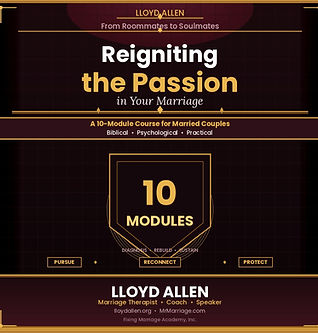
From Roommates to Soulmates: Reigniting the Passion in Your Marriage
The roommate marriage is not a destination anyone chose. It is the result of a thousand small choices to let the connection slide.
The first step toward soulmate marriage is the willingness to name, without blame, exactly how the distance grew — and to make the decision together that it ends here.